
DEVOPS ENGINEERING PROGRAM
1) Who Is This Course For? Students who want to start a career in software development. Beginners with no prior programming experience who want to become developers. IT graduates looking to gain practical full stack development skills. Working professionals who …
Overview
1) Who Is This Course For?
- Students who want to start a career in software development.
- Beginners with no prior programming experience who want to become developers.
- IT graduates looking to gain practical full stack development skills.
- Working professionals who want to switch their career into the tech industry.
- Freelancers who want to build and deploy web applications for clients.
- Anyone interested in learning how websites and web applications are built from scratch to deployment.
2) Certification
On successful completion of the Diploma in Full Stack Development, learners will receive a Diploma Certificate in Full Stack Development.
The certification validates your ability to:
- Develop front-end and back-end applications.
- Work with databases and APIs.
- Build responsive and interactive web applications.
- Understand software development lifecycle and deployment processes.
3) Learning Outcomes
By the end of this program, learners will be able to:
- Understand core web technologies: HTML, CSS, and JavaScript.
- Build responsive and modern user interfaces using front-end frameworks.
- Develop server-side applications using back-end technologies.
- Create and manage databases for web applications.
- Design and develop RESTful APIs.
- Integrate front-end and back-end systems effectively.
- Deploy web applications to cloud or hosting platforms.
- Work with version control systems like Git and GitHub.
- Develop real-world full stack projects from scratch.
- Gain job-ready skills for roles such as Full Stack Developer, Web Developer, or Software Engineer.
Curriculum
- 9 Sections
- 59 Lessons
- 12 Weeks
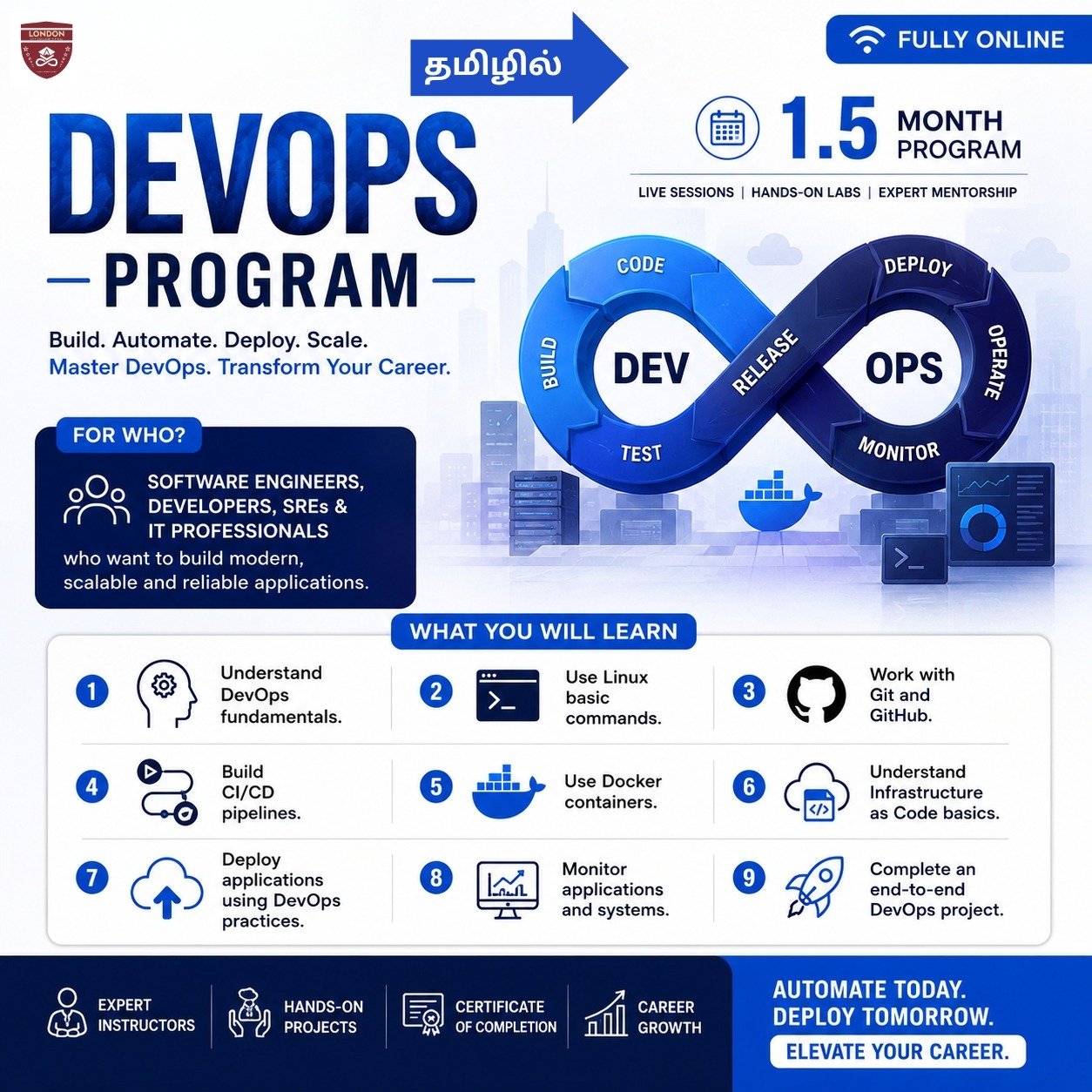
- Module 1: Understand DevOps Fundamentals10
- Module 2: Use Linux Basic Commands6
- Module 3: Work with Git and GitHub4
- Module 4: Build CI/CD Pipelines7
- Module 5: Use Docker Containers5
- Module 6: Understand Infrastructure as Code Basics6
- Module 7: Deploy Applications Using DevOps Practices8
- Module 8: Monitor Applications and Systems5
- Module 9: Complete an End-to-End DevOps Project8
- 9.11. Plan and version control the project
- 9.22. Write the application code
- 9.33. Create a Dockerfile and containerize the app
- 9.44. Define infrastructure as code (IaC)
- 9.55. Set up a CI/CD pipeline
- 9.66. Configure monitoring and logging
- 9.77. Deploy using a robust strategy
- 9.88. Document and run a post‑mortem
Instructor

FAQs
Requirements
- User-Friendly Interface
- Robust Course Management Capabilities
- Effective Communication and Collaboration
Features
- User-Friendly Interface
- Communication and Collaboration
- Course Management
Target audiences
- Educational Institutions
- Businesses and Organization
- Individual Learners
You May Like

QuickBooks 01 Month Practical Program
This tutorial will introduce you to PHP, a server-side scripting language you can use to make dynamic websites and web applications.
AutoCAD
By the end of this program, students will be able to: 1. Understand the fundamentals and interface of AutoCAD software 2. Create accurate 2D drawings...

Xero Accounting Certificate Program
1) Who Is This Course For? Students who want to build a career in Accounting and Finance. Beginners who want to learn cloud-based accounting...
Diploma In Full Stack Development
1) Who Is This Course For? Students who want to start a career in software development. Beginners with no prior programming experience who want to...
Course Features
- Lectures 59
- Quiz 0
- Duration 12 weeks
- Skill level All levels
- Language English
- Students 348
- Assessments Yes